Back to Main Timeline
Preponderance Finding · Evidentiary Limits

The Panel's
Determination

The University of South Carolina's Title IX panel returned a “more likely than not” determination of responsibility for dating violence. The evidentiary record available to that determination was constrained by procedural rules limiting the introduction of contextual evidence.

Pre-Conclusion

1. Terminology and Architecture

In the framing language of the proceeding itself, the complainant was designated as the survivor from the outset, before evidence was introduced, before the panel had convened, before any finding of fact had been made. This designation appeared in office correspondence, in hearing-stage materials, and in the working vocabulary of the administrators conducting the matter.

The choice of nomenclature is not a stylistic flourish. To label one party as a survivor is to presuppose the existence of the harm whose existence the proceeding is nominally convened to determine. The respondent was, by symmetric implication, the party from whom survival had occurred.

The architecture of the hearing reinforced this premise. A physical partition was placed between the parties during the proceeding, an arrangement that presumes the complainant required shielding from the respondent. The protective posture, like the terminology, treats the harm as a working assumption rather than a question for the panel.

A proceeding that begins from these presumptions is not a proceeding that tests whether the harm occurred. It is a proceeding that calibrates the institutional response to a harm whose occurrence has already been accepted as a working premise. The evidentiary rules described below operate against the backdrop of that premise, not against a neutral one.

Standard & Constraint

2. The Evidentiary Frame

The panel proceeded under the “more likely than not” (preponderance) standard, the lowest evidentiary threshold available in any adjudicative process. A bare majority of perceived likelihood was sufficient to return a finding of responsibility.

The introduction of evidence by the respondent was simultaneously restricted under an “isolated event” framing: material falling outside the specific time window selected for the indictment was treated as non-cognizable. Counter-evidence relevant to context, pattern, or character of the relationship was excluded from full consideration on this basis.

The boundaries of what evidence the respondent could introduce were also applied inconsistently. Certain materials the respondent was advised in advance he would be permitted to discuss were, when raised at the hearing itself, met with interruption and immediate exclusion. The respondent had no reliable guidance, at the moment of presentation, as to what would actually be permitted into the record, and no opportunity to revise his case in light of the rulings made against him in real time.

The net procedural posture: the lowest applicable standard of proof, paired with the highest applicable constraint on counter-evidentiary scope, applied through rules whose contours shifted between the pre-hearing guidance and the hearing itself.

Contemporaneous Record

3. Text Communications from the Time Frame

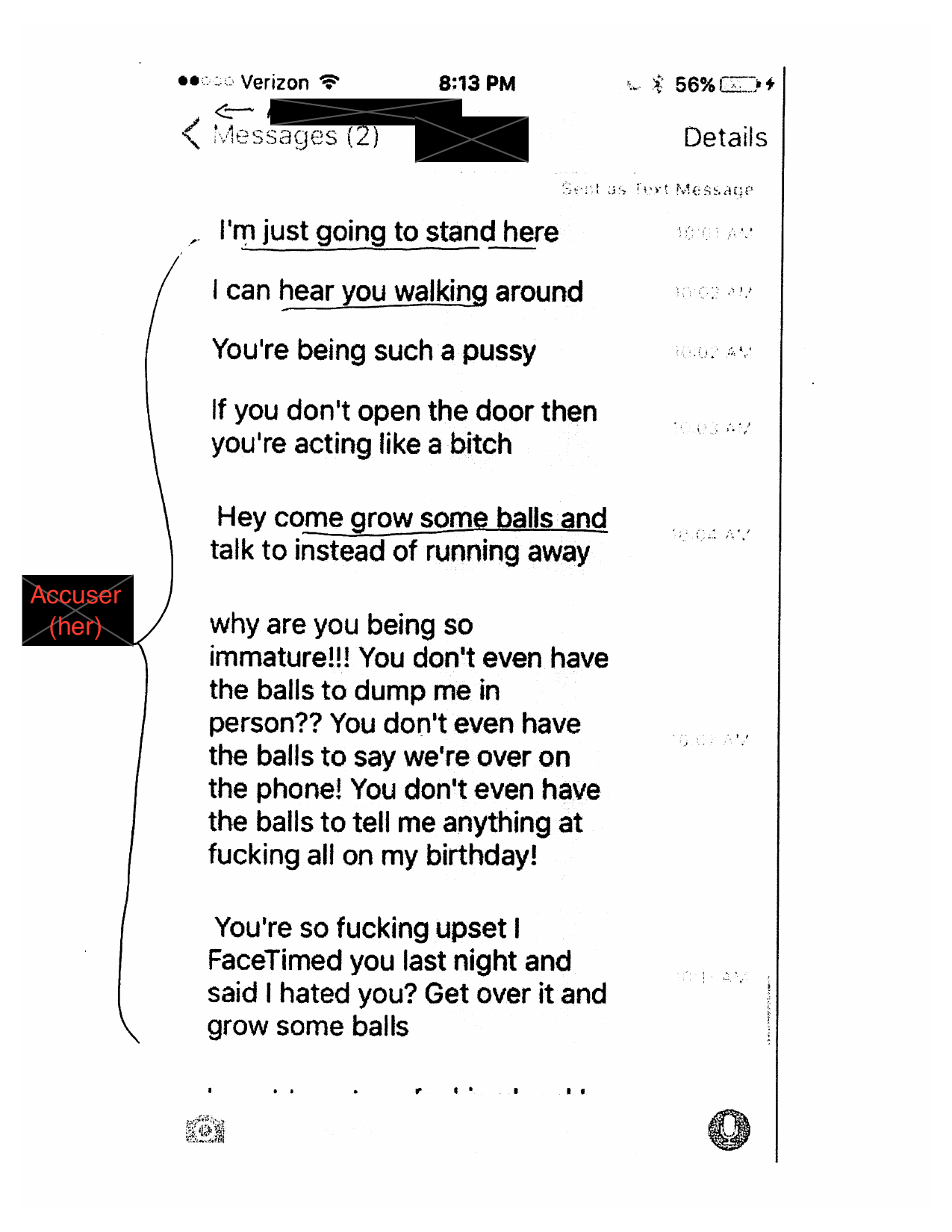
The following exchange consists of contemporaneous text messages between the parties from the period relevant to the determination. The communications existed at the time of the proceeding and were available for consideration. They are reproduced here as part of the documented record. Identifying information has been redacted; the parties are designated by their procedural role only.

Contemporaneous text communication exhibit, page 1
Exhibit T · Page 1 of 3
Contemporaneous text communication exhibit, page 2
Exhibit T · Page 2 of 3
Contemporaneous text communication exhibit, page 3
Exhibit T · Page 3 of 3

“Contemporaneous communications from the relevant time frame, available to the proceeding, reflecting the pattern of interaction between the parties.”

Parallel Exclusion

4. Medical Records Used in the Indictment

Closer examination of the medical records being used by the indicting party was also constrained during the proceeding. Selectively included pages were admitted as evidence against the respondent, while the full clinical record and the independent expert clinical analysis (the “Harvard Letter”) were excluded.

This pattern is documented in detail at Medical Record Mishandling.

Outcome

5. The Determination

Notwithstanding the contemporaneous record described above, and the parallel constraints placed on the respondent's access to the medical record being used against him, the panel returned a finding of responsibility under the preponderance standard.

The procedural framing of what could and could not be presented determined what the panel was permitted to weigh. The determination is the product of that framing as much as it is the product of the facts.

Note on Scope

This page documents the procedural posture of the determination and the evidentiary record available to it. The materials reproduced here are presented to illustrate the constraints imposed on the respondent's ability to introduce contextual evidence, not to relitigate the underlying interpersonal dispute.